|
|
 |
|
|
|
register |
bbs |
search |
rss |
faq |
about
|
|
|
meet up |
add to del.icio.us |
digg it
|
|
|
| Mad Scientists Science and Mathematics discussion-- theories, arguments, citations, proofs and pudding. |
 |
|
# 1


2008-10-24, 15:21
|
|
|
 Virus Biology
What the hell is a virus? I know bacteria are single celled organisms but in this tutorial I'm reading it says a virus is just "genetic information surrounded by a protein coat. They may have a membrane". Are these things even considered living organisms?
A bit of DNA surrounded by some proteins. It interesting shit the way viruses work and if they really are this simple then it wouldn't be too hard for scientists to create their own viruses. They could even make symbiotic viruses rather than parasitic ones. I suppose thats the direction bionanotechnology is heading.
|
# 2
2008-10-24, 15:32
|
|
Regular
|
|
the happy land of australia
|
|
Re: Virus Biology
they are barely considered alive, just packets for replicating DNA.
a couple of years ago scientists did manage to make a virus, i remember posting about it here (should be in the archives).
i think it will be a very long time before useful viruses are unleashed on the public though.
|
# 3
2008-10-24, 15:41
|
|
|
Re: Virus Biology
Ah I get it. Fairly similar to computer viruses aren't they. A bit of code (genetic information) that infects computers (cells). Interesting shit I never knew about this. I thought viruses were the same as bacteria.
Chemical computers thats all cells really are. Now I see where all this cutting edge nanotechnology is coming from. We're back engineering ourselves.
So is DNA basically just chemically encoded instructions that direct all of our metabolism?
|
# 4
2008-10-24, 16:11
|
|
|
Re: Virus Biology
One thing I can't figure out is what a chromosome is. Is a single chromosome just a single DNA molecule packages by proteins?
|
# 5
2008-10-25, 01:59
|
|
Regular
|
|
Exploding dome [head] syndrome

|
|
Re: Virus Biology
Quote:
Originally Posted by MrSparkle

One thing I can't figure out is what a chromosome is. Is a single chromosome just a single DNA molecule packages by proteins?
|
thats what im led to believe.
|
# 6
2008-10-27, 03:01
|
|
|
Re: Virus Biology
Quote:
Originally Posted by MrSparkle
One thing I can't figure out is what a chromosome is. Is a single chromosome just a single DNA molecule packages by proteins?
|
To understand what a chromosome is you need to understand how a cell stores genetic information. Within the nucleus of a cell, when a cell is not in the process of mitosis (replication), the genetic information , or DNA is uncoiled. Think of it as a giant ball of string, just unwound and floating around. When the cell enters its replication cycle it condenses the DNA into single chromosomes (23 in humans). To do this the DNA strand is wrapped around a protein complex called histones which then supercoil around themselves. This greatly condenses the DNA to the point where it can by seen under microscopes. At this point the supercoiled DNA looks a bit like a hot dog. Just a cylinder. To replicate properly the single chromosome replicates its self and takes on the classic X configuration, joined in the centre by a protein called a centrosome. In essence a chromosome is just like a spool. Our cells configure DNA into these structures to make it easier to move around. Think about trying to move 100 metres of string while it was unwound. Now think about how easy it would be if that string was wound around something. Cells are amazing things when you consider that if you stretched out all the DNA in a single cell it would form a thin fibre about 3 metres in length.
/rant.
ask and ye shall recieve

|
# 7
2008-10-27, 04:05
|
|
Regular
|
|
The little land of Oz
|
|
 Re: Virus Biology
^^^ Just to expand on that, that's a nice, concise description of Eukaryotic chromosomes. (That would be us.)
But for Prokaryotes (bacteria, etc) there are no histones and the chromosome exists as a supercoiled ring.
Ans for viruses - I'd be here forever trying to explain what states the chromosmes/genomes exist in in different types and at different times.
|
# 8
2008-10-27, 12:07
|
|
|
Re: Virus Biology
Thats a good explanation Brown thanks. So chromosomes are only formed right before the cell replicates? Alot of places they say "the nucleus contains chromosomes" but thats not really accurate is it. The nucleus contains chromosomes for a certain period of time before the cell splits.
So this 3 meter length of DNA is it all one big molecule?
I just looked up the centrosome on wiki and it refers to it as an organelle. You called it a protein. Can a protein by itself be considered an organelle?
Is this red dot the centrosome?
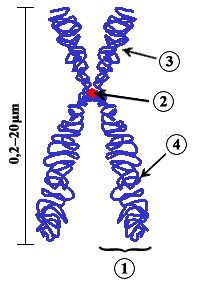
flatplat: Yea I noticed theres some big differences between prokaryotes and eukaryotes. These microorganisms interest me more than eukaryotes but I have to start learning somewhere so I'm gonna gain a good understanding of animal cells first.
Last edited by MrSparkle; 2008-10-27 at 12:20.
|
# 9
2008-10-27, 13:06
|
|
Regular
|
|
Exploding dome [head] syndrome
|
|
Re: Virus Biology
http://en.wikipedia.org/wiki/Centromere
|
# 10
2008-10-27, 14:27
|
|
Regular
|
|
the happy land of australia
|
|
Re: Virus Biology
heres the thread i was referring to
http://www.totse.com/community/showthread.php?t=1994016
|
|
#11
2008-10-27, 14:41 |
Brown_Town 
Regular
|
|
|
|
Re: Virus Biology
Yes, they are formed just before a cell replicates.
That statement is accurate to a degree. The nucleus of a cell technically contains chromosomes. But those chromosomes are in their decompressed form, called chromatin. It's just a double strand of DNA.
The 3 metres is an approximation. And no, the length is cumulative. Since we have 23 chromosomes and 1 strand of DNA will form 1 chromosome, I would assume there are 23 separate lengths of DNA. Instead of referring to it as a molecule you should refer to it as a protein (nit-picking).
I may have confused myself with the centromere. It`s either the centromere or centrosome that holds the two copies of a chromosome together. They have similar names, sue me for getting it wrong. I`m pretty sure that whatever it is that holds the two copies together is a protein. And no, proteins cannot be organells by themselves.
Yes the red dot is the centrosome/ centromere.
Hope that helps.
|
|
#12
2008-10-27, 17:49 |
|
|
Re: Virus Biology
Yes, they are formed just before a cell replicates.
That statement is accurate to a degree. The nucleus of a cell technically contains chromosomes. But those chromosomes are in their decompressed form, called chromatin. It's just a double strand of DNA.
They are still chromosomes throughout the cell cycle (whether they are condensed or not) and the DNA is always packaged into chromatin. Chromatin is any DNA that is associated with histones (and some other proteins). A chromosome is two single strands of DNA that make up one double stranded piece of DNA in the cell.
|
|
#13
2008-10-27, 23:33 |
Brown_Town
Regular
|
|
|
|
Re: Virus Biology
They are still chromosomes throughout the cell cycle (whether they are condensed or not) and the DNA is always packaged into chromatin. Chromatin is any DNA that is associated with histones (and some other proteins). A chromosome is two single strands of DNA that make up one double stranded piece of DNA in the cell.
Yes this is right, but I was tryin not to confuse him. DNA is technically always a part of a chromosome, but when I was referring to a chromosome I meant the structure in general.
|
|
#14
2008-10-28, 12:39 |
|
Regular
|
|
The little land of Oz
|
|
Re: Virus Biology
flatplat: Yea I noticed theres some big differences between prokaryotes and eukaryotes. These microorganisms interest me more than eukaryotes but I have to start learning somewhere so I'm gonna gain a good understanding of animal cells first.
Fair enough. :) But you do realize you're staring with the more complicated ones, right?
|
|
#15
2008-10-28, 16:18 |
|
|
Re: Virus Biology
Well there are eukaryotic micoorganisms too, but they are generally more complex than bacteria.
|
|
#16
2008-10-28, 22:42 |
Chibi Shinigami
Regular
|
|
|
|
Re: Virus Biology
Quote:
|
Originally Posted by MrSparkle
What the hell is a virus? I know bacteria are single celled organisms but in this tutorial I'm reading it says a virus is just "genetic information surrounded by a protein coat. They may have a membrane". Are these things even considered living organisms?
A bit of DNA surrounded by some proteins. It interesting shit the way viruses work and if they really are this simple then it wouldn't be too hard for scientists to create their own viruses. They could even make symbiotic viruses rather than parasitic ones. I suppose thats the direction bionanotechnology is heading.
|
Actually...not quite true. Viruses don't have DNA - they use RNA as their genetic material.
Viruses are NOT considered 'cells' of any sort...but that doesn't mean they aren't alive. |
|
#17
2008-10-29, 03:38 |
Mantikore
Regular
|
|
|
|
Re: Virus Biology
im pretty sure viruses have DNA, and retro viruses have RNA
|
|
#18
2008-10-29, 04:22 |
|
|
Re: Virus Biology
Viruses can have DNA or RNA, single stranded or double stranded. Retroviruses are RNA viruses that use a reverse transcriptase to synthesize DNA from their RNA.
|
|
#19
2008-11-05, 11:27 |
kwijyfaw
Regular
|
|
|
|
Re: Virus Biology
if you want to nitpick, here are some addendums
are virus alive?
depends on what your definition of life is. lots of scientists still debate on it
dna is not a protein. not sure where you got this.
dna is a polymer made of subunits called nucleotides.
protein is a polymer made of subunits called amino acids.
chromatin is not just a double strand of dna.
chromatin is a complex of dna and proteins (mainly histones). chromatin is what chromosome is made of
chromatin is not the decompressed form of chromosomes.
chromaTIN may take on a "compressed" form and it may also take on a "decompressed" form.
the compressed form is called heterochromatin. decompressed is called euchromatin.
i dont study bacteria so i dont know if this is the same thing for those guys..
whoever said "3m long dna"=> you meant to say 3m long chromosome
whatever real pua said is the truth
|
|
#20
2008-11-16, 02:37 |
Gallows
Regular
|
|
|
|
Re: Virus Biology
To understand what a chromosome is you need to understand how a cell stores genetic information. Within the nucleus of a cell, when a cell is not in the process of mitosis (replication), the genetic information , or DNA is uncoiled. Think of it as a giant ball of string, just unwound and floating around. When the cell enters its replication cycle it condenses the DNA into single chromosomes (23 in humans). To do this the DNA strand is wrapped around a protein complex called histones which then supercoil around themselves. This greatly condenses the DNA to the point where it can by seen under microscopes. At this point the supercoiled DNA looks a bit like a hot dog. Just a cylinder. To replicate properly the single chromosome replicates its self and takes on the classic X configuration, joined in the centre by a protein called a centrosome. In essence a chromosome is just like a spool. Our cells configure DNA into these structures to make it easier to move around. Think about trying to move 100 metres of string while it was unwound. Now think about how easy it would be if that string was wound around something. Cells are amazing things when you consider that if you stretched out all the DNA in a single cell it would form a thin fibre about 3 metres in length.
/rant.
ask and ye shall recieve
The cell replicates DNA during inter phase. Mitoses is cell replication. Also, if the cell went into mitosis with 23 single chromosomes, well, it wouldn't be a pretty sight. It enters mitosis with 46 replicated chromosomes. Two cells with 46 un-replicated chromosomes are the result.
|
|
#21
2008-11-21, 09:29 |
|
Regular
|
|
run while you can ----->
|
|
Re: Virus Biology
A virus is something that hijacks a cell for use as it's own "factory", which then burst's releasing more of said virus, which repeat the process.
|
| Thread Tools |
 Show Printable Version  Email this Page
|
| Display Modes |
 Linear Mode Linear Mode Switch to Hybrid Mode  Switch to Threaded Mode
|
 Posting Rules
|
You may not post new threads
You may not post replies
You may not post attachments
You may not edit your posts
HTML code is Off
|
|
|
|
|
|
To the best of our knowledge, the text on this page may be freely reproduced and distributed.

totse.com certificate signatures
|
|
|
About | Community | Bad Ideas | Drugs | Ego | Erotica | Fringe | Society | Technology
|
|
|
|
|
|
![]()
![]()
|


 Virus Biology
