|
|
 |
|
|
|
register |
bbs |
search |
rss |
faq |
about
|
|
|
meet up |
add to del.icio.us |
digg it
|
|
|
| Mad Scientists Science and Mathematics discussion-- theories, arguments, citations, proofs and pudding. |
 |
|
# 1


2008-09-01, 03:57
|
|
|
 Centrifugal force at the equator.
Because the earth's equator is spinning pretty fast (1200km/h?), what effect does this have on weights? If you had a 1000 gram block of steel as measured at the south pole, wouldn't it weigh slightly less at the equator, due to the spin of the earth pushing it outwards?
How much difference would there be?
|
# 2
2008-09-01, 20:34
|
|
|
Re: Centrifugal force at the equator.
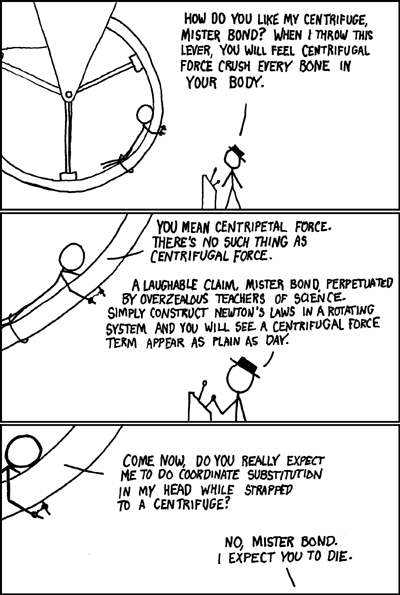
I remember being taught the there was no such thing as centrifugal force...
Last edited by Goldo; 2008-09-01 at 20:39.
|
# 3
2008-09-02, 01:36
|
|
Regular
|
|
http://tinyurl.com/6rwkpu
|
|
Re: Centrifugal force at the equator.
It's centripetal.
And the force acts inwards.
And it has little to do with weight.
The block will weigh less at the equator because it is farther from the center of mass of the Earth, therefore the force of gravity is less, because force is indirectly related to the square of distance.
F = GMm/R²
|
# 4
2008-09-02, 01:46
|
|
Regular
|
|
The Big Rock Candy Mountains
|
|
Re: Centrifugal force at the equator.
Quote:
Originally Posted by 23

It's centripetal.
And the force acts inwards.
And it has little to do with weight.
The block will weigh less at the equator because it is farther from the center of mass of the Earth, therefore the force of gravity is less, because force is indirectly related to the square of distance.
F = GMm/R²
|
Well there is a virtual force there, which is called centrifugal force, which is actually inertia, but the result is that you would weigh less at the equator than at the poles.
|
# 5
2008-09-02, 04:22
|
|
Regular
|
|
Portsmouth, VA 23702
|
|
Re: Centrifugal force at the equator.
First of all, the question is kind of a trick. Grams are a unit of mass, weight is a unit of force. A 1000 gram block has a mass of 1000 grams regardless of the forces acting on it.
Second, imagine the Earth as a hollow sphere. If you're on the outside of the sphere, you experience centrifugal force, which would cause you to fly away from the sphere. If you're on the inside, you experience centripetal force, which is the effect of the "floor" pushing you back in (in simple terms).
Now, if you think about centrifugal force, it's actually the result of inertia, like OneMestizo said. Inertia would cause you to move at the same speed and the same direction. That direction would be perpendicular to the gravity force of the Earth. As physics class tells you, forces that act perpendicular to each other have no effect on each other.
So, the WEIGHT of a steel block on the equator would be the same as the WEIGHT of a steel block on a pole.
That's my reasoning after 4 shots of tequilla, anyway.
|
# 6
2008-09-02, 07:08
|
|
|
 Re: Centrifugal force at the equator.
Quote:
Originally Posted by Goldo
I remember being taught the there was no such thing as centrifugal force...
|
|
# 7
2008-09-02, 18:54
|
|
Regular
|
|
The Big Rock Candy Mountains
|
|
Re: Centrifugal force at the equator.
Quote:
Originally Posted by DoctorDoom
First of all, the question is kind of a trick. Grams are a unit of mass, weight is a unit of force. A 1000 gram block has a mass of 1000 grams regardless of the forces acting on it.
Second, imagine the Earth as a hollow sphere. If you're on the outside of the sphere, you experience centrifugal force, which would cause you to fly away from the sphere. If you're on the inside, you experience centripetal force, which is the effect of the "floor" pushing you back in (in simple terms).
Now, if you think about centrifugal force, it's actually the result of inertia, like OneMestizo said. Inertia would cause you to move at the same speed and the same direction. That direction would be perpendicular to the gravity force of the Earth. As physics class tells you, forces that act perpendicular to each other have no effect on each other.
So, the WEIGHT of a steel block on the equator would be the same as the WEIGHT of a steel block on a pole.
That's my reasoning after 4 shots of tequilla, anyway.
|
Well kinda. First off, the whole inside/outside earth analogy is misleading. Centripetal force is what keeps object in a circular or elliptical motion. Think a swinging a ball on the end of a string, or planets orbiting around the sun. In the latter, the centripetal force comes from gravity, which is what keeps US moving in a circular path around the earth's center of gravity.
If you think about the person on the inside of the hollow earth-sphere, he feels like he is being "pushed" toward the floor or the shell of the sphere he is standing. That is centrifugal force. But really both of these forces are felt by everyone whether they are inside our outside earth.
And no, the centrifugal force is not really perpendicular to the force of earths gravity. Think about a circle. To anyone standing around this circle, the center of the circle is 'down'. 'Up' is the opposite of down, radiating outward from the center point. Now, if a person were to fly off the earth, he would follow the path of a line tangent to the circle. Now, he is traveling in a straight line, but to everyone else still on the circle, he would appear to be moving up, because thats the way his body tends, away from the center of the circle.
So essentially, the centrifugal "force" and the force of gravity are in opposite directions of another, so their vectors simply add. If we take "weight" for a moment here to mean the reading on a scale you're standing on, your weight then is the difference of the force of gravity on you, and the centrifugal force.
And obviously, centrifugal force is going to change depending on your latitude, with the most pronounced effects occurring a the equator. The net force on your body then decreases the closer you get to the equator, so your apparent weight would decrease.

|
# 8
2008-09-04, 19:17
|
|
Acolyte
|
|
halfway between here and there
|
|
Re: Centrifugal force at the equator.
Since noone is answering the question directly, polar weight=150lbs, equatorial weight=149.5 lbs.
not much difference.
|
# 9
2008-09-04, 22:19
|
|
|
Re: Centrifugal force at the equator.
Well, don't forget that the radius from the center to the earth to one of the poles is 6356.8 km compared to the equatorial radius which is 6378.1 km. This is because of exactly what you were describing, but those extra 21.3 km have got to have a small effect on the reduction in weight as well.
__________________
You don't have to think I'm right, as long as you think.
|
# 10
2008-09-04, 23:15
|
|
|
Re: Centrifugal force at the equator.
Quote:
Originally Posted by OneMestizo
And no, the centrifugal force is not really perpendicular to the force of earths gravity. Think about a circle. To anyone standing around this circle, the center of the circle is 'down'. 'Up' is the opposite of down, radiating outward from the center point. Now, if a person were to fly off the earth, he would follow the path of a line tangent to the circle. Now, he is traveling in a straight line, but to everyone else still on the circle, he would appear to be moving up, because thats the way his body tends, away from the center of the circle.
So essentially, the centrifugal "force" and the force of gravity are in opposite directions of another, so their vectors simply add.
|
Centrifugal force only acts until you leave the surface. and It's perpindicular until you leave the surface.
|
|
#11
2008-09-04, 23:23 |
|
Regular
|
|
The Big Rock Candy Mountains
|
|
Re: Centrifugal force at the equator.
Centrifugal force only acts until you leave the surface. and It's perpindicular until you leave the surface.
Perpendicular to the earth or the force of gravity?
|
|
#12
2008-09-07, 00:33 |
Ormy 
Regular
|
|
|
|
Re: Centrifugal force at the equator.
OneMestizo has it right, weight at the equator is fractionally less due to centrifugal force (inertia), but its insignificant compared to the force of gravity itself. You would never notice without quite sensitive equipment. Even less significant is the lower weight due to your being slightly further away from the earth's CoM at the equator than the poles. You would need very very sensitive equipment to meaure this.
|
|
#13
2008-09-07, 00:44 |
bobfish
Regular
|
|
|
|
Re: Centrifugal force at the equator.
Or a large weight and an accurate, high capacity scale.
|
|
#14
2008-09-07, 02:26 |
Mik-O
Regular
|
|
|
|
Re: Centrifugal force at the equator.
Quote:
|
Originally Posted by DoctorDoom
First of all, the question is kind of a trick. Grams are a unit of mass, weight is a unit of force. A 1000 gram block has a mass of 1000 grams regardless of the forces acting on it.
Second, imagine the Earth as a hollow sphere. If you're on the outside of the sphere, you experience centrifugal force, which would cause you to fly away from the sphere. If you're on the inside, you experience centripetal force, which is the effect of the "floor" pushing you back in (in simple terms).
Now, if you think about centrifugal force, it's actually the result of inertia, like OneMestizo said. Inertia would cause you to move at the same speed and the same direction. That direction would be perpendicular to the gravity force of the Earth. As physics class tells you, forces that act perpendicular to each other have no effect on each other.
So, the WEIGHT of a steel block on the equator would be the same as the WEIGHT of a steel block on a pole.
That's my reasoning after 4 shots of tequilla, anyway.
|
4 shots eh, not bad reasoning.
in a nutshell yes
as long as the earth isn't accelerating/decellerating, the weight will stay the same... yes? or does that refer to the statement of; any experiment on motion, tested in a still environment, or a moving one (assuming the motion is constant) will yield no different results...? |
|
#15
2008-09-21, 08:18 |
LavaRed
Regular
|
|
|
|
Re: Centrifugal force at the equator.
You're all forgetting that the Earth is wider at the equater precisely because of this tangential effect of inertia.;)
|
|
#16
2008-09-22, 15:08 |
bobfish
Regular
|
|
|
|
Re: Centrifugal force at the equator.
No, I factored that into this answer.
Since noone is answering the question directly, polar weight=150lbs, equatorial weight=149.5 lbs.
not much difference.
|
|
#17
2008-09-25, 03:03 |
|
|
Re: Centrifugal force at the equator.
Yes you would weigh less at the equator.
I hate all this word mincing that comes up when someone says centrifugal instead of centripetal or whatever.
Thinking about it with centrifugal force, you are thrown slightly outwards by the rotation of the earth. Gravity-amount thrown outwards=weight, so yes, you weigh slightly less
Thinking with centripetal, it takes a certain amount of centripetal force to keep you tracking a circle, and since you are tracking a circle (when was the last time you flew into space due to the earths rotation?) clearly that force exists, and clearly it must come from somewhere. Namely, it subtracts from any force currently pushing you downward. If there isn't a force pushing you outward, you will fly off.
Both ways of thinking about it, the answer is the same.
PS: Posted this in the wrong thread originally :(
|
|
#18
2008-09-26, 04:48 |
Ormy
Regular
|
|
|
|
Re: Centrifugal force at the equator.
As another proof of this, it is known that when flying easterly on concorde (mach 2) you weigh 1.4% less due to your additional rotational speed.
|
| Thread Tools |
 Show Printable Version  Email this Page
|
| Display Modes |
 Linear Mode Linear Mode Switch to Hybrid Mode  Switch to Threaded Mode
|
 Posting Rules
|
You may not post new threads
You may not post replies
You may not post attachments
You may not edit your posts
HTML code is Off
|
|
|
|
|
|
To the best of our knowledge, the text on this page may be freely reproduced and distributed.

totse.com certificate signatures
|
|
|
About | Community | Bad Ideas | Drugs | Ego | Erotica | Fringe | Society | Technology
|
|
|
|
|
|
![]()
![]()
|


 Centrifugal force at the equator.


